
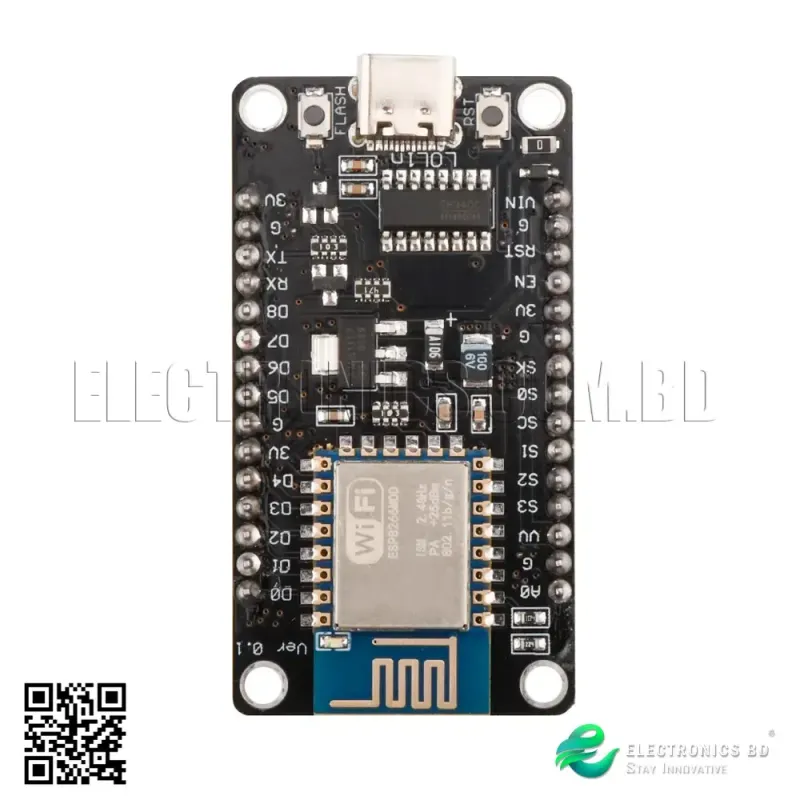
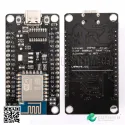
Product Detail
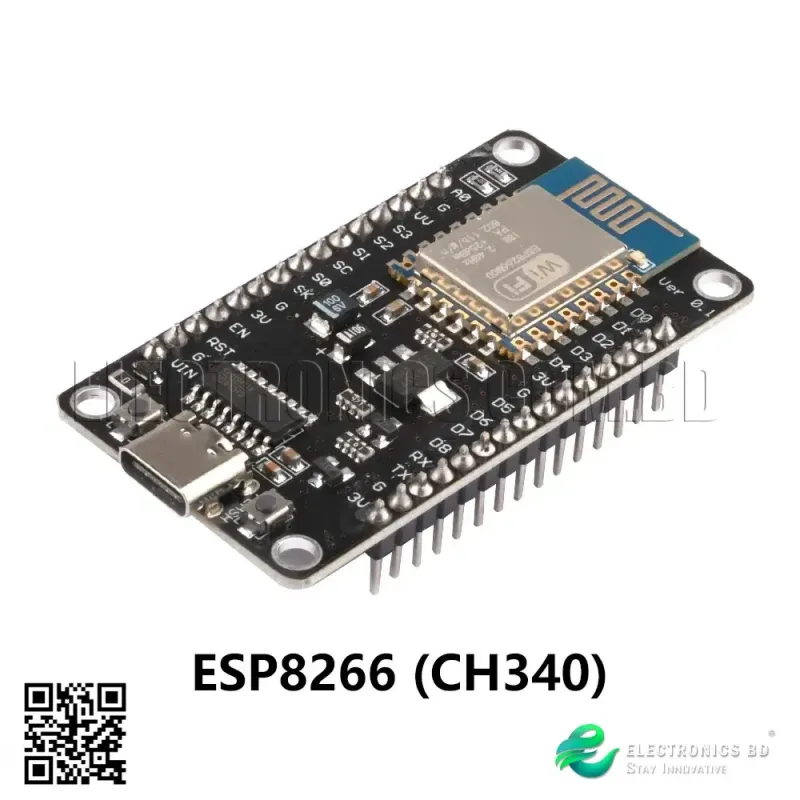
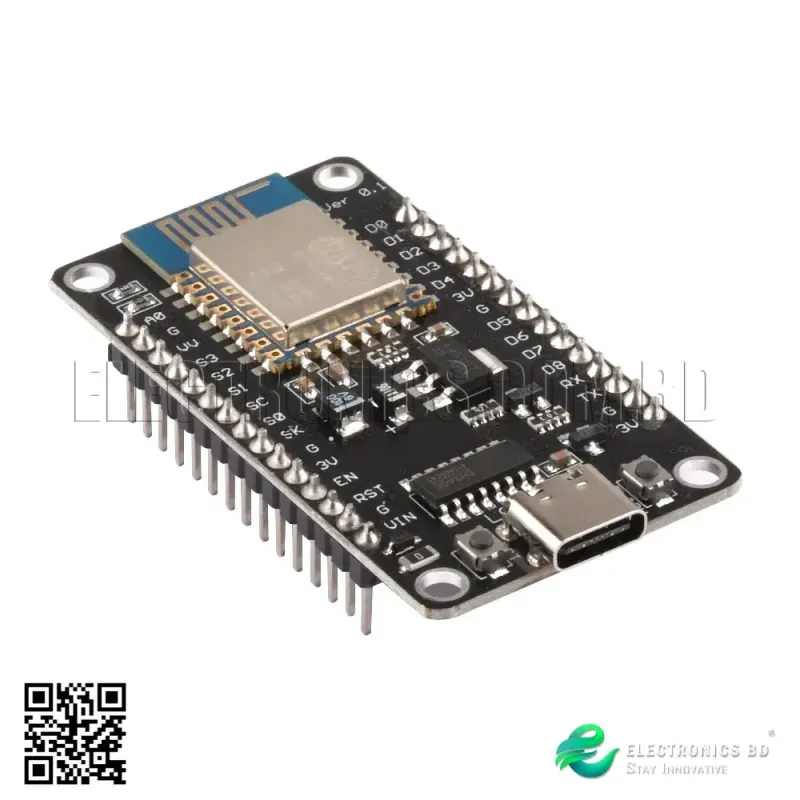
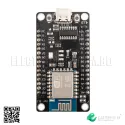
The NodeMCU Lua Lolin V3 ESP8266 ESP-12F Type-C WiFi Development Board is a compact and powerful IoT platform based on the ESP8266 microcontroller.
It comes with an integrated WiFi module and a CH340 USB-to-Serial chip for reliable connectivity and programming.
With support for the Type-C USB port, this version offers better compatibility and durability. It includes 17 GPIO pins configurable as PWM, UART, I²C, or SPI interfaces —
making it perfect for prototyping smart devices, automation systems, and wireless projects.
Its lightweight design, 4MB flash memory, and 32-bit processor provide a balance of power and simplicity for both beginners and advanced developers.
Features:
- Microcontroller: ESP8266 ESP-12F
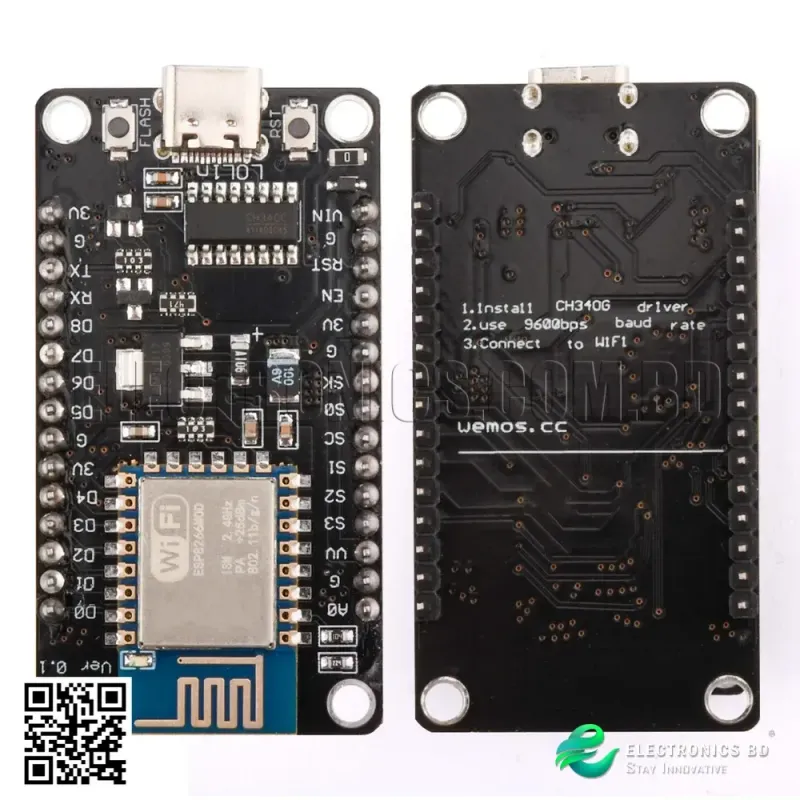
- Built-in CH340 USB to Serial interface
- Type-C USB connector for stable data transfer
- 80/160 MHz adjustable clock frequency
- Supports Lua scripting and Arduino IDE
- Onboard WiFi 802.11 b/g/n
- Auto-reset for easy programming
- Compact and breadboard-friendly design
Applications:
- IoT device prototyping
- Smart home automation systems
- Remote sensor data monitoring
- Wireless network control projects
- Arduino and Lua-based experiments
Technical Specifications:
| Parameter | Value |
|---|---|
| Model | NodeMCU Lolin V3 ESP8266 ESP-12F |
| Microcontroller | ESP8266 (32-bit) |
| Supply Voltage (USB) | 5V DC |
| Operating Voltage (I/O) | 3.3V DC |
| Clock Frequency | 80 / 160 MHz |
| Instruction RAM | 32KB |
| Data RAM | 96KB |
| External Flash Memory | 4MB |
| GPIO Pins | 17 (PWM capable, 3.3V logic) |
| ADC (Analog Input) | 1 (0–1V range) |
| UART Ports | 2 |
| USB Interface | Type-C (CH340 driver) |
| WiFi Standard | 802.11 b/g/n |
| Color | Black |
⚙️ Please allow 3% measuring deviation.
Package:
-
1 × NodeMCU Lua Lolin V3 Module ESP8266 ESP-12F Type-C WiFi Development Board with CH340
Documentations:
What is NodeMCU Lolin V3 ESP8266?
NodeMCU Lolin V3 ESP8266 is an open-source development board designed for IoT applications.
It combines a WiFi-enabled ESP8266 microcontroller with easy programming through Lua scripts or the Arduino IDE.
The board allows developers to connect devices to the internet quickly for smart home, monitoring, or control projects.
NodeMCU Lolin V3 ESP8266 Video
How to Use:
- Install the CH340 driver on your PC or laptop.
- Connect the board via a Type-C USB cable.
- Open the Arduino IDE or NodeMCU Lua environment.
- Select the correct COM port and “NodeMCU 1.0 (ESP-12E Module)” from the board list.
- Upload your code or Lua script to start running WiFi-based projects.
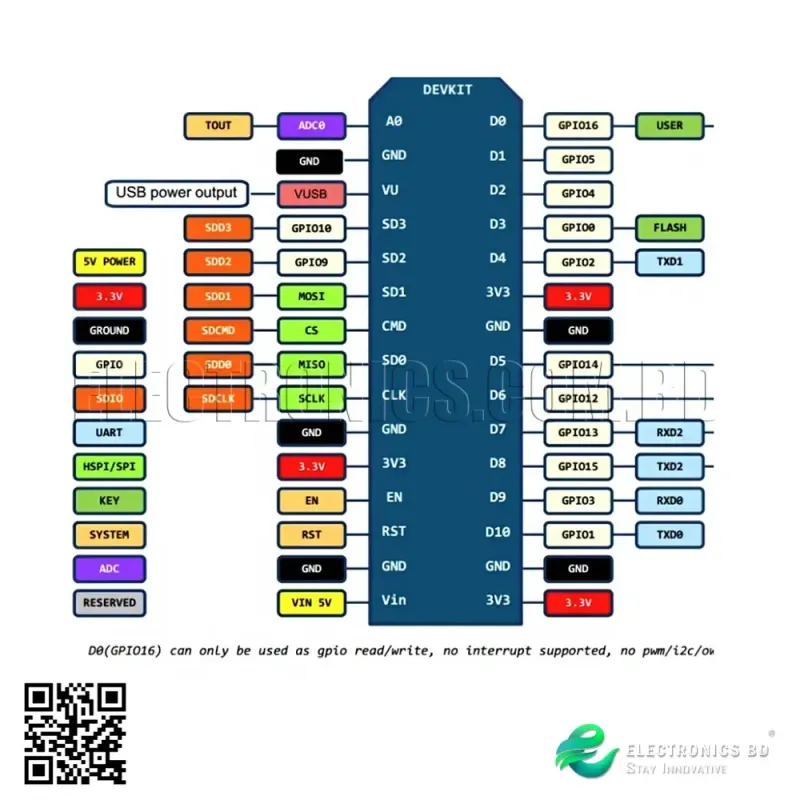
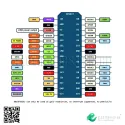
NodeMCU Lolin V3 Pinout:
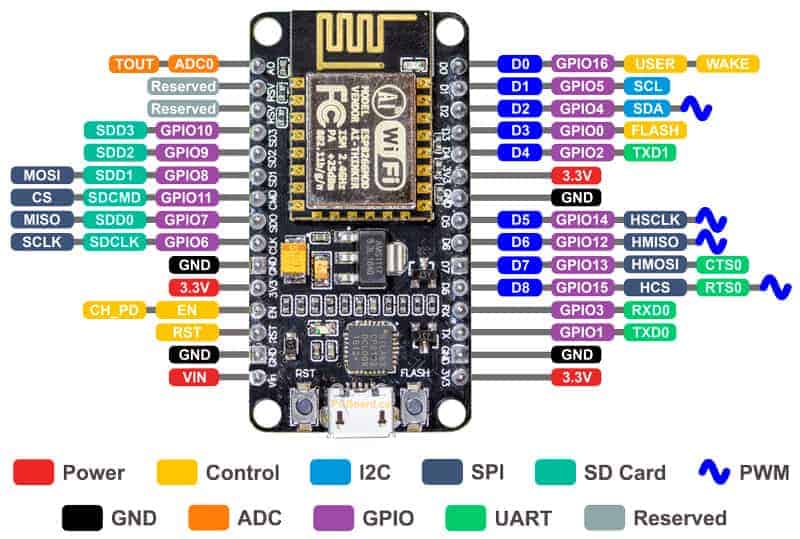
Power Pins There are four power pins. VIN pin and three 3.3V pins.
- VIN can be used to directly supply the NodeMCU/ESP8266 and its peripherals.
Power delivered on VIN is regulated through the onboard regulator on the NodeMCU module – you can also supply 5V regulated to the VIN pin - 3.3V pins are the output of the onboard voltage regulator and can be used to supply power to external components.
GND are the ground pins of NodeMCU/ESP8266
I2C Pins are used to connect I2C sensors and peripherals. Both I2C Master and I2C Slave are supported.
I2C interface functionality can be realized programmatically, and the clock frequency is 100 kHz at a maximum.
It should be noted that I2C clock frequency should be higher than the slowest clock frequency of the slave device.
GPIO Pins NodeMCU/ESP8266 has 17 GPIO pins which can be assigned to functions such as I2C, I2S, UART, PWM,
IR Remote Control, LED Light and Button programmatically. Each digital enabled GPIO can be configured to internal pull-up or pull-down,
or set to high impedance. When configured as an input, it can also be set to edge-trigger or level-trigger to generate CPU interrupts.
ADC Channel The NodeMCU is embedded with a 10-bit precision SAR ADC.
The two functions can be implemented using ADC.
Testing power supply voltage of VDD3P3 pin and testing input voltage of TOUT pin.
However, they cannot be implemented at the same time.
UART Pins NodeMCU/ESP8266 has 2 UART interfaces (UART0 and UART1) which provide asynchronous communication (RS232 and RS485),
and can communicate at up to 4.5 Mbps. UART0 (TXD0, RXD0, RST0 & CTS0 pins) can be used for communication.
However, UART1 (TXD1 pin) features only data transmit signal so, it is usually used for printing log.
SPI Pins NodeMCU/ESP8266 features two SPIs (SPI and HSPI) in slave and master modes.
These SPIs also support the following general-purpose SPI features:
- 4 timing modes of the SPI format transfer
- Up to 80 MHz and the divided clocks of 80 MHz
- Up to 64-Byte FIFO
SDIO Pins NodeMCU/ESP8266 features Secure Digital Input/Output Interface (SDIO) which is used to directly interface SD cards.
4-bit 25 MHz SDIO v1.1 and 4-bit 50 MHz SDIO v2.0 are supported.
PWM Pins The board has 4 channels of Pulse Width Modulation (PWM). The PWM output can be implemented programmatically and used for driving digital motors and LEDs. PWM frequency range is adjustable from 1000 μs to 10000 μs (100 Hz and 1 kHz).
Control Pins are used to control the NodeMCU/ESP8266. These pins include Chip Enable pin (EN), Reset pin (RST) and WAKE pin.
- EN: The ESP8266 chip is enabled when EN pin is pulled HIGH. When pulled LOW the chip works at minimum power.
- RST: RST pin is used to reset the ESP8266 chip.
- WAKE: Wake pin is used to wake the chip from deep-sleep.
Control Pins are used to control the NodeMCU/ESP8266. These pins include Chip Enable pin (EN), Reset pin (RST) and WAKE pin.
- EN: The ESP8266 chip is enabled when EN pin is pulled HIGH. When pulled LOW the chip works at minimum power.
- RST: RST pin is used to reset the ESP8266 chip.
- WAKE: Wake pin is used to wake the chip from deep-sleep.
Applications:
- WiFi-enabled sensor nodes
- Smart lighting and automation
- IoT data collection
- Cloud-connected systems
- Wireless control modules
FAQ:
- 1. Is this board compatible with Arduino IDE?
→ Yes, it’s fully compatible with Arduino IDE using the ESP8266 board package. - 2. Does it support Type-C USB?
→ Yes, this version uses a Type-C interface for reliable connection. - 3. Which driver is required for USB connection?
→ The board uses the CH340 USB-to-serial driver. - 4. Can I power it directly with 5V?
→ Yes, through the Type-C USB port or 5V pin. - 5. What’s the difference between Lolin V3 and earlier NodeMCU versions?
→ The Lolin V3 includes a Type-C port, improved PCB layout, and CH340 driver for stable data communication.
Reference Links:
Specifications
Lorem Ipsum is simply dummy text of the printing and typesetting industry. Lorem Ipsum has been the industry's standard dummy text ever since the 1500s, when an unknown printer took a galley of type and scrambled it to make a type specimen book. It has survived not only five centuries.
- Model SKU140
- Weight 500 g
- Dimensions 35 × 30 × 7 cm
- Color Black, Pink, Red, White
- Size 10 X 20
Reviews

It's hard to find faults with the NodeMCU Lua Lolin V3 Module ESP8266 ESP-12F Type C WIFI Wifi Development Board with CH340.
Add a Review
Related Products
- 12.00
- |82
- |
1K RFID NFC Smart Card | 13.56MHz Contactless IC Card | Access Control & ID Card
- 40.00
- |0
- |W-15
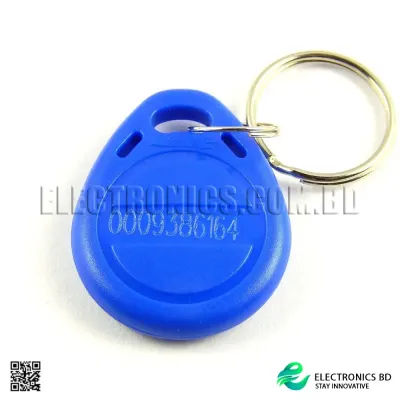
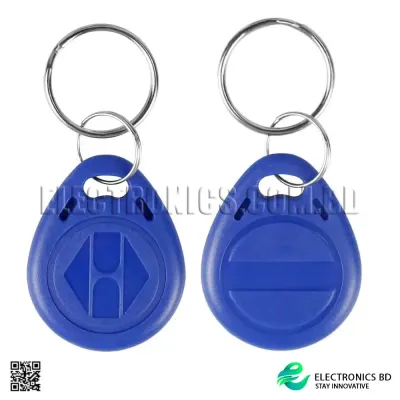
125kHz RFID Key Tag EM4100 Proximity ID Token for Access Control
- 900.00
- |2
- |B-96